This is the article I was looking for 20 years ago when I first started hunting trophy brown trout on this river. Not a general overview of trout fishing on the Hooch, not a basic gear list, and not the usual advice about checking the dam schedule that applies to any fish you might target here. This is specifically about the Chattahoochee’s wild brown trout — understanding what they are, where they live, how they behave across seasons, and the specific strategies that consistently produce the largest fish in this river.
Let me start with something that took me longer than I care to admit to fully internalize. The big brown trout in the Chattahoochee River are not the same fish as the stocked rainbows that share their water. They live differently, feed differently, hold differently, and demand a completely different approach. If you walk up to a prime run below Buford Dam, spot rising fish everywhere, and proceed to work it with a size 20 Zebra Midge under an indicator, you will catch rainbows all day. But if there is a large brown in that pool — and there may well be — you will probably not touch it. The fish that grow to trophy size on this river have survived by not eating the same things the ten-inch stockers eat, in the same places the ten-inch stockers hold, in the same way the ten-inch stockers expose themselves to danger. Fishing for them requires a fundamentally different mindset from the moment you step into the water.
UNDERSTANDING THE CHATTAHOOCHEE’S BROWN TROUT POPULATION
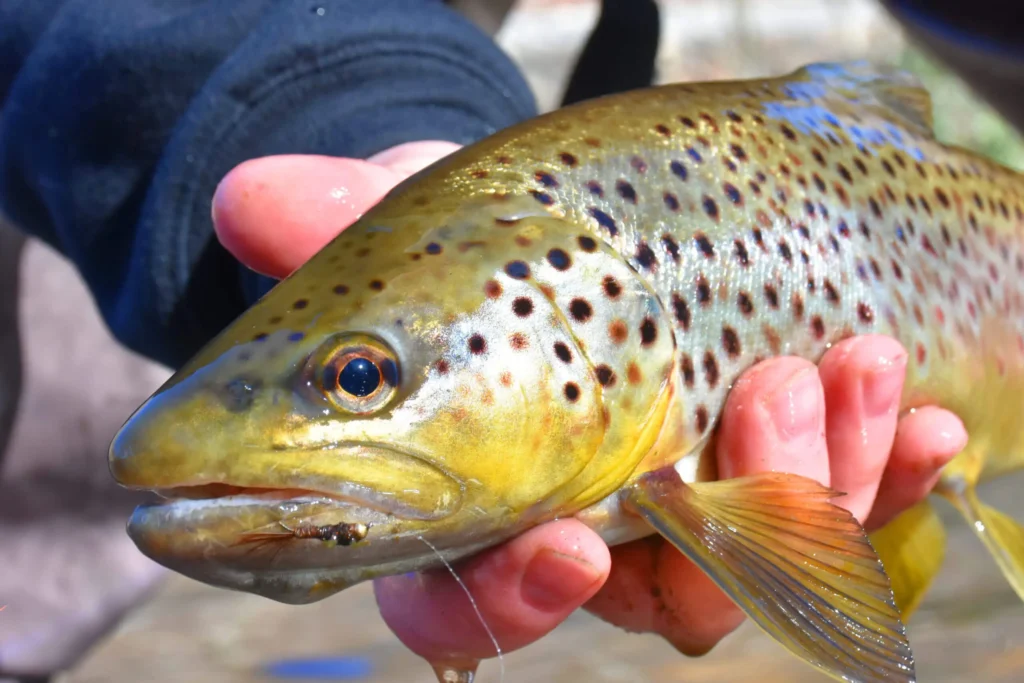
The brown trout in the Chattahoochee tailwater below Buford Dam are wild fish. Georgia DNR stopped stocking brown trout in this river in 2008 after confirming that the population was successfully self-sustaining through natural reproduction. Every large brown you encounter in this river today is the product of wild spawning that has been occurring for decades in the rocky gravel redds of the upper tailwater corridor, primarily in November and December when water temperatures drop toward fifty degrees and the browns’ spawning instinct overrides everything else they do.
The strain that established itself here is the Walhalla strain, originally sourced from South Carolina, which proved significantly superior to the Plymouth Rock strain in both hatchery survival rates and field performance in the Chattahoochee specifically. Georgia DNR’s research comparing the two strains found the Walhalla fish showed measurable growth in both length and weight after stocking, while the Plymouth Rock strain did not. What that means practically is that the Chattahoochee’s brown trout population has genetic roots in a strain selected specifically for this river, and it has been adapting to tailwater conditions in this corridor for going on forty years.
The current Georgia state record brown trout came from this river. On July 27, 2014, Chad Doughty of Winder was kayak fishing below Buford Dam when he hooked a brown trout on a Rooster Tail inline spinner with six-pound test spinning gear. He fought that fish for forty-five minutes, eventually abandoning his kayak and running the fish down on foot when his reel threatened to run out of line. When weighed on certified scales, the fish registered twenty pounds and fourteen ounces and measured thirty-one and a half inches — the largest brown trout ever officially recorded in Georgia, beating the previous state record by more than two pounds. That previous record had also come from the Chattahoochee, caught in November 2001 and weighing eighteen pounds six ounces.
Those records represent the ceiling of what this river produces, but they are not aberrations. Georgia DNR biologists have told the Atlanta Fly Fishing Club that many brown trout heavier than ten pounds live in the thirty miles of river from Buford Dam to Morgan Falls Dam. Guide Chad Bryson, who has been running trophy brown trips on the Hooch for decades out of The Fish Hawk fly shop in Atlanta, has landed and photographed fish estimated at nearly eighteen pounds on this river. A DNR tagging study from 2011 to 2012 found that more than eighty percent of brown trout sampled measured between seventeen and twenty-seven centimeters, but the study also confirmed rapid initial growth, with fish likely reaching quality size within two years and larger fish showing accelerated growth as they transition to a fish-dominated diet.
That last point is the key to understanding why big browns get big, and why they behave the way they do. Once a brown trout reaches a size where it can eat other fish efficiently, its growth rate increases dramatically. A large brown is not competing with stocked rainbows for midge larvae. It is eating those stocked rainbows. The Chattahoochee’s continuous rainbow stocking program, which puts tens of thousands of nine-to-eleven-inch catchable fish into the river each week throughout the year, functions as a delivery service for the river’s trophy browns. This is one of the primary reasons this river grows such exceptional brown trout despite being under enormous fishing pressure — the food source for large predatory fish is virtually unlimited.
Brown trout are also substantially more territorial than rainbows and have a documented tendency to hold in the same lies for extended periods. A DNR tagging study on the Chattahoochee found minimal movement between sites by tagged brown trout — once a large brown establishes a prime feeding territory on this river, it tends to stay. This means that identifying prime brown trout water is not just productive today; it is productive on every subsequent trip to the same location.
READING WATER FOR BIG BROWNS: THINKING LIKE A PREDATOR
The most important shift in perspective when targeting trophy brown trout is moving from thinking about feeding lanes to thinking about ambush positions. The stocked rainbow trout in the Chattahoochee hold in textbook feeding positions — current seams, tail-outs of pools, soft water behind mid-current boulders where drifting insects are funneled into a predictable delivery path. Large browns are rarely found in these positions during daylight hours. They are ambush predators that spend the majority of their time holding in positions that optimize their ability to attack, not positions that maximize their exposure to drifting insects.
What you are looking for when hunting big browns on the Hooch is structure that provides four specific characteristics simultaneously: depth sufficient to conceal a large fish, proximity to current that delivers food, shade or overhead cover that reduces the fish’s exposure to aerial predators and angler visibility, and a hard substrate or structural edge that allows the fish to face the current with minimal energy expenditure.
On the Chattahoochee tailwater specifically, the structure that most consistently holds trophy browns is blowdowns. The banks of the Hooch throughout the tailwater corridor are heavily eroded and actively collapsing into the river, and the result is an abundance of submerged and partially submerged trees, root masses, and log jams along both banks for the entire length of the fishery. This woody structure is the most important habitat feature for large brown trout on this river, and it is the reason many of the biggest browns come from hard-to-reach bank sections that most anglers never present a lure or fly to effectively. The fish Bryson and Scalley and the other experienced guides target first are the ones tucked under root balls on the outside bends, sitting in the deep shadow of a half-submerged sweeper, or holding against a fallen tree that deflects the main current and creates a protected slack-water pocket with depth immediately alongside it.
Deep pools below significant drops and rapid sections are the other primary holding area for large browns on the Hooch. The river has a series of defined pool-riffle sequences throughout its length, and the deepest pools — particularly those with an abrupt transition from fast water above to a significant depth increase in the pool itself — are classic trophy brown habitat. The fish hold near the bottom of these pools, often tighter to the downstream end where the pool transitions back to shallower water and current narrows, creating a natural funnel. A brown holding at the bottom of a six-foot-deep pool at the tail-out transition can survey a significant amount of drifting food with minimal movement, and bolt into shallower water to attack if a small fish presents itself in the zone above.
Undercut banks on outside river bends are the third consistent big-brown feature on the Chattahoochee. The erosive forces that have created so much blowdown structure on this river have also cut significant undercut banks along many of the pronounced outside bends throughout the tailwater corridor. A large brown parked under an undercut bank is nearly invisible from the surface and has overhead protection, depth, and the ability to move in any direction to attack prey. These positions require precise casts parallel to the bank or tight under the overhanging bank edge to be effective, and they are essentially inaccessible to wading anglers approaching from the same side of the river. This is one of the primary reasons float fishing from a drift boat produces disproportionately large browns on the Chattahoochee — it gives the angler presentation angles that wading anglers cannot achieve.
The deeper channel sections of the river — particularly in the mid-tailwater from Medlock Bridge south through Jones Bridge and into Island Ford — hold their own population of large browns that have settled into the deeper, slower water and adopted a feeding strategy focused on the river’s substantial carp and bass forage, as well as the stocked trout that migrate downstream. DNR biologists have noted that brown trout tend to be more prolific and larger as you move downstream from Morgan Falls Dam, which reflects the more complex forage base and habitat diversity in the lower tailwater corridor.
STRATEGY ONE: STREAMER FISHING FOR TROPHY BROWNS
Streamer fishing is the most direct method for targeting the largest brown trout in the Chattahoochee and the approach that the river’s experienced guides prioritize when they have clients specifically after a fish of a lifetime. The logic is straightforward — a large streamer filters out smaller fish and specifically targets the predatory browns that have committed to a fish-based diet. You will not catch numbers on a streamer the way you catch numbers on a tandem midge rig under an indicator. What you will do, on the right days in the right conditions with the right presentation, is connect with a fish you will remember for the rest of your life.
The gear for streamer fishing trophy browns on the Chattahoochee is different from standard tailwater setup. You need at minimum a six-weight rod, and an eight-weight is not too much if you are throwing large articulated patterns. Guide Chad Bryson casts eight-weight rods with large flies on full-sink lines when specifically targeting trophy browns, and that setup reflects decades of focused experience on this fishery. A six or seven weight is adequate for most anglers throwing flies in the four-to-six-inch range. The rod needs genuine backbone — you need to be able to move a heavy articulated fly on a sink-tip line against current all day without fatigue, and you will occasionally need to turn a large fish in heavy water at short range.
Line selection matters for streamer fishing on the Hooch in ways it does not for nymphing. A standard floating WF5F line is not adequate for getting large streamers to depth in the Chattahoochee’s faster runs and deeper pools. The two primary options are a full-sink line — which gets flies deepest and produces the most consistent depth throughout the drift and retrieve — and a sink-tip line, typically with a ten-to-fifteen-foot sinking section rated at type III or type IV, which is easier to cast and mend than a full-sink but still reaches productive depth in most tailwater water types. Rio and Scientific Anglers both make purpose-designed streamer lines in these configurations. For wade fishing situations on the Hooch, a type III sink-tip is the most versatile choice. For float fishing where you are working deeper channel edges from a boat, a full-sink line or type V sink-tip reaches the depth where big browns park in mid-river.
Leader and tippet for streamer fishing is simple — fluorocarbon, heavy, short. A two-to-three-foot section of 1X or 0X fluorocarbon directly off the fly line or off a short braided mono leader is correct. Brown trout are not leader shy when attacking a baitfish imitation and there is no advantage to fishing light tippet to a large streamer. The advantage is entirely on the other side of the equation: a large brown hooked in heavy current with a full-sink line and a big articulated fly is a serious adversary on any weight tippet, and the sixteen-pound fluorocarbon that seems heavy in the fly shop will feel absolutely appropriate when you have a ten-pound brown tail-walking downstream in a generation release.
For fly selection, the Woolly Bugger in white, size 4 to 6, is the essential entry point for brown trout streamers on the Chattahoochee. The white Bugger imitates the threadfin shad and blueback herring that are the Hooch’s primary baitfish and that large browns key on, particularly in the upper tailwater where cold-weather baitfish kill events flush dead and injured shad through the dam turbines. Dead-drift a white Woolly Bugger on a full-sink line through the channel edges below the dam when water temperatures drop significantly in January and February and you have arrived at the single most productive big-brown method available on the upper tailwater.
Beyond the Woolly Bugger, large articulated streamers tied on two hooks with substantial marabou and rabbit strip bodies are the upper tier of trophy brown streamer fishing on the Hooch. Kelly Galloup’s Dungeon and the Sex Dungeon are patterns specifically designed for this type of fishing and both have track records on this river. Chad Bryson has developed his own Chattahoochee-specific patterns — the Chattahoochee Double Deceiver, the Filthy Beggar, and the River Raptor — that are purpose-built for this fishery by someone who has been targeting its biggest fish for decades. Blane Chocklett’s Game Changer in a white or natural baitfish color is worth carrying as a second option — its multi-jointed articulated body produces a swimming action that is genuinely different from every other streamer in the box and can move fish that have seen everything else.
Colors for Chattahoochee streamer fishing: white and white/chartreuse are the primary baitfish colors for the upper tailwater. Olive and olive/black produce well in low-light conditions and darker water. Black is an underrated choice in low light or at dawn, when the silhouette of a dark streamer against the sky is more visible to a looking fish than a lighter color. Natural tan-and-brown sculpin-imitating colors produce in the sections below Highway 20 where sculpin populations are more abundant in the cobble-bottomed sections.
The retrieve approach for Chattahoochee streamer fishing depends significantly on whether you are fishing from a boat or wading. From a drift boat, the classic bank-shot approach — casting tight to the bank structure and stripping the fly away from the bank at an angle as the boat moves downstream — is devastatingly effective on the blowdown-lined banks of the tailwater. The fly presents directly in the brown’s field of view as it exits the cover, and the angling retrieve forces the fish to commit or let the prey escape. Strip hard, strip erratically, strip fast enough to stay ahead of the boat drift but not so fast that the fly rises out of the strike zone.
From a wading position, the quartering downstream cast with a sink-tip line is the foundational technique. Cast downstream and across at roughly a forty-five-degree angle, mend line upstream to allow the fly to sink as it swings toward the near bank, and work the fly with strips and pauses as it completes its arc through the target water. The pause is critically important — many of the strikes on streamer fishing come when the fly decelerates or stops, mimicking an injured baitfish that pauses when it tires. After the fly swings to the dangle position directly below you, strip it with short aggressive strips before picking up for the next cast. A surprising percentage of follows and takes happen at the dangle.
Cover water. This is the non-negotiable principle of trophy streamer fishing on the Chattahoochee and it runs counter to the instincts developed through nymphing, where you work productive water methodically and milk a good run for every fish. A predatory brown that sees your streamer and is willing to eat it will hit it on the first or second presentation. If it does not, move downstream and make new water. The fish you are looking for are spread across miles of river, not concentrated in predictable feeding lanes. Every cast to water you have already shown the fly to is a cast taken away from new water where a big brown might be waiting.
STRATEGY TWO: DEEP NYMPHING WITH HEAVY RIGS
This is the most consistent approach for catching large browns that are not actively pursuing baitfish — the fish that are feeding subsurface on nymphs, sculpin, crayfish, and the other bottom-dwelling food sources that make up a significant part of even a large brown’s diet. The distinction between nymphing for stocked rainbows and nymphing specifically for large browns is almost entirely about depth and presentation zone.
Large brown trout feed close to the bottom. Very close. Research on tailwater brown trout consistently shows fish holding within six inches of the substrate, and a fly that is drifting at mid-depth in a four-foot pool is effectively invisible to a brown parked on the gravel at the bottom. The mistake I see from anglers who are fishing the right water with the right flies but not touching browns is insufficient weight. They are fishing shallower than they think they are, and they are fishing the rainbow water without knowing it.
The setup for deep nymphing for browns is a long, heavily weighted indicator rig. The total leader and tippet system needs to be one and a half to two times the depth of water you are fishing — if you are targeting a six-foot pool, your indicator should be set for nine to twelve feet, not four feet. The weight — split shot or tungsten putty — should be sufficient to tick the bottom occasionally on every drift. Not dragging and not bouncing constantly, but touching down intermittently. That contact with the substrate is the physical confirmation that your fly is in the zone where large browns feed.
Fly selection for targeting large browns nymphing on the Chattahoochee shifts toward larger, more visible flies than the midge-dominated rigs that produce rainbows in the upper tailwater. A size 10 or 12 Pat’s Rubber Legs — the classic Montana stonefly nymph with articulated rubber legs in black/brown or the natural color — is a first choice for targeting large browns in the deeper runs and pool sections throughout the tailwater. Browns respond to the movement of the rubber legs with what can only be described as predatory confidence. They do not inspect the fly the way rainbows examine a size 20 midge pupa. They eat it.
A large bead-head Hare’s Ear or an outsized Copper John in size 10 as the point fly, with a San Juan Worm in size 12 as the trailing fly, is a heavy tandem rig that produces consistently on large browns through the mid-tailwater sections. The San Juan Worm is underestimated by many fly anglers who consider it too simple to be taken seriously, but the Hooch’s browns eat worms aggressively and the UV-enhanced versions produce particular results in the slightly stained water conditions that characterize much of the river’s mid-section after rain events.
During brown trout spawn season — November through December, with some activity into January — Y2K egg patterns become one of the most effective flies in the river. Female browns deposit eggs in redds throughout the upper tailwater during the spawn, and stray eggs drift downstream in the current continuously. Non-spawning browns, particularly large males that are actively patrolling the spawning areas, eat these eggs opportunistically and sometimes almost exclusively. A peach or cream Y2K egg pattern on a size 10 hook, fished as the trailing fly below a Pat’s Rubber Legs, is the deadliest spawning season rig available for large Chattahoochee browns. This is not an approach universally loved in fly fishing circles because targeting actively spawning fish raises ethical considerations — I fish egg patterns, but I do not fish them on active redds or in water I can clearly see contains spawning fish.
STRATEGY THREE: FISHING THE DAM RELEASE WINDOWS
This strategy is specific to the Chattahoochee in a way that has no direct parallel on most other trout streams, and it is one of the most consistently productive tactics for large browns available anywhere on the tailwater. The relationship between dam generation releases and large brown trout feeding activity on the Hooch is direct and predictable once you understand the mechanism.
When Buford Dam releases water for power generation — typically weekday afternoons as electric demand peaks, but possible any time — the river rises dramatically and the current velocity through the upper tailwater increases by a factor of two or more within minutes. Baitfish — threadfin shad and blueback herring that exist in large numbers in the Lake Lanier water column — are swept through the generating turbines and either killed or injured in transit. These dead and stunned baitfish enter the river at the base of the dam and drift downstream in the faster current created by the generation release itself.
Large brown trout know this. They have learned it through experience the same way any predator learns a reliable food source, and the response of big browns to a generation event in the upper tailwater is one of the most dramatic feeding behaviors I have witnessed on any river. As the water rises and the baitfish begin to arrive, browns that spend most of their time tucked under blowdowns and in deep holding water move into feeding positions in the channel. The combination of increased current velocity that pins prey against structure and channel edges, plus the actual delivery of dead and injured baitfish on the drift, creates a feeding opportunity that large browns exploit aggressively.
The critical timing consideration is that you need to be out of the water before the release arrives and back in — if regulations and conditions allow — as the flow stabilizes at the elevated level. The upper tailwater above Highway 20 requires a PFD by law, and the rapid rise during a generation event in this section is genuinely dangerous. Do not wade the upper tailwater during a release. Wade the sections south of Highway 20 during elevated but stable post-generation flows, which is where this strategy is most applicable as a wading approach.
The productive fishing window for large browns following a generation release typically begins fifteen to thirty minutes after flow stabilizes at the elevated level and extends for one to two hours before the river drops back toward baseline. In this window, a large white streamer dead-drifted through the channel edges and along the blowdown banks of the mid-tailwater is the most effective presentation available. The fish are feeding, the food source is white-colored baitfish, and the elevated flow naturally concentrates prey against the structural margins of the river.
The best access points for fishing the post-release window on the Hooch are from a kayak or drift boat in the mid-tailwater corridor. A kayak angler who knows the release schedule and positions in the mid-tailwater south of Highway 20 before the afternoon release, exits the water and waits on the bank during the rise, and then relaunches to fish the two-hour post-release window from the kayak with a heavy white streamer fished along the bank structure is executing as effective a plan for a large Chattahoochee brown as any approach available on this river. This is not theoretical. The Georgia state record came from exactly this area, caught by a kayak angler on a spinning lure, on a day when the river was running elevated.
STRATEGY FOUR: COLD SNAP BAITFISH KILL FISHING
This strategy is the most opportunistic and the most spectacularly productive when the conditions align. It requires monitoring Lake Lanier and upper Chattahoochee water temperatures in late fall and winter, watching for the extended cold snap events that push surface water temperatures in the reservoir into the low forties.
When Lake Lanier’s surface temperature drops sufficiently during a sustained cold event — typically a multi-day period with overnight temperatures well below freezing — the lake’s shallow-water threadfin shad and blueback herring populations experience mass die-offs. These are warm-water baitfish that cannot survive temperatures below approximately forty-two degrees Fahrenheit for extended periods, and a genuine cold snap in January or February can kill enormous numbers of them. When Buford Dam generates power during or immediately after such an event, it draws from the colder, denser bottom water in the reservoir and flushes large quantities of dead and dying baitfish through the turbines and into the river below the dam.
The fishing that follows a major baitfish kill event on the Chattahoochee is difficult to overstate. The upper tailwater below the dam transforms into an active feeding environment for every large predatory fish in the system, including not just the resident brown trout but also striped bass that migrate upstream from below Morgan Falls. The big browns are concentrated in the channel and along the structural edges of the upper tailwater, actively feeding on baitfish that the average dead-drift angler fishing a size 20 Zebra Midge will walk right past without triggering a single strike.
The correct approach during a baitfish kill event is a large white fly dead-drifted through the channel on a sink-tip or full-sink line. The key word is dead-drifted. You are not stripping the fly aggressively or imparting action. You are mimicking a dead baitfish drifting in the current, which is exactly what the large browns are eating. The presentation is almost identical to high-stick nymphing except that the fly is a four-to-six-inch white streamer rather than a midge pupa. A white Woolly Bugger in size 4 or 6 on a full-sink line with enough weight to keep it near the bottom of the channel is the most accessible version of this technique. Large articulated white patterns with marabou bodies — the kind of flies Bryson and the other Chattahoochee guides fish specifically for this event — are the upper tier.
On spinning gear, a white inline spinner — a Worden’s Rooster Tail or Panther Martin in all-white — or a white countdown Rapala worked slowly through the channel on the downstream drift is an effective analog to the white streamer technique for spin anglers.
STRATEGY FIVE: SIGHT FISHING FOR LARGE BROWNS
This is the most technically demanding approach and the one that produces the most specific satisfaction when it works. The Chattahoochee’s brown trout are visible fish in clear-water conditions — not easy to see, not obvious at first, but findable by an angler who has developed their ability to read form, shadow, and movement in moving water. Learning to see them changes everything about how you fish this river.
Large browns hold in different positions than rainbows in almost every case. While rainbows in the upper tailwater are spread throughout the current-broken water of the channel, a large brown will be a solitary fish tucked against the deepest edge of a pool, positioned in the shadow of a root ball at the base of a blowdown, or sitting in the flat calm of an inside bend where the current slows to near-stillness. They do not visually pop out of the water column the way feeding rainbows do. You are looking for a shape on the substrate, a dark form against the lighter gravel — something larger and with a more deliberate, less animated movement than the nervous activity of stockers.
The best conditions for sight fishing large browns on the Hooch are low, clear water in early morning light approaching from a high bank position with the sun behind you. The pools at Jones Bridge, the accessible inside bends at Settles Bridge, and several specific sections of the mid-tailwater between Medlock and Jones Bridge in low-flow late-summer conditions all produce sight-fishing opportunities if you slow down and look before you wade in.
When you find a large brown and can see it clearly enough to understand its position and orientation, the approach to that fish needs to be different from any approach you would use for a stocked rainbow. You will not make ten casts over it while you adjust your indicator depth. You have a small number of acceptable presentations — two or three at most in the right direction — before the fish becomes aware of you and shuts down or moves. Approach from downstream, stay low, make no wake, and keep your shadow off the fish at all costs. Position yourself far enough away to present the fly cleanly without line falling over the fish and make the first cast count.
For sight-nymphing a visible large brown, a heavy point fly with a small natural-colored dropper is a more reliable choice than a midge-dominant rig. A size 12 Pat’s Rubber Legs as the point with a size 16 Pheasant Tail or Copper John as the dropper, weighted heavily enough to sink immediately to the fish’s feeding depth, presented slightly upstream of the fish’s position with enough lead to allow the rig to sink to the fish’s level before it arrives in the feeding zone — this is the correct approach.
For a visible fish that appears to be actively looking for prey rather than holding in a focused feeding position, a large sculpin-pattern nymph dead-drifted directly in front of its nose can produce a strike that is aggressive enough to make you lose focus for a moment. Browns that are in a predatory mode respond to large food items with decisiveness that does not look like a trout eating a midge.
STRATEGY SIX: FISHING AT NIGHT AND VERY EARLY MORNING
I will not tell you to fish at night because it is illegal on the Chattahoochee tailwater from Buford Dam to Peachtree Creek — no fishing within thirty minutes of sunset to thirty minutes before sunrise. But I will tell you that the fifteen-to-thirty-minute window on either side of first light, in the period before full daylight when the regulations are technically met, is the single most productive time of day to connect with a large brown trout on this river.
Brown trout are crepuscular predators. They are genetically wired to be most active in low light, and the fishing pressure pattern on the Chattahoochee further reinforces this — the river gets heavy angler traffic from first light through mid-morning on most days, and large browns have learned that daylight and angler presence are correlated. The fish that grow to double digits in a heavily pressured river do so partly by concentrating their feeding activity in periods and locations where pressure is lowest.
The first cast of the morning in the gray pre-dawn light, a large streamer fired tight to a blowdown on the far bank before the sun is fully up and before any other angler has put the river on alert, is one of the highest-probability moments available for a large Chattahoochee brown. Arrive at your section before legal fishing time, rig up in the dark, and be in position to make that first cast the moment legal fishing begins. Do not ease into the river. Do not splash. Do not turn on a headlamp. Become part of the riverbank in the low light and cast as quietly and precisely as the conditions will allow.
The period following afternoon generation events in late fall, when the last hour of legal light coincides with elevated flows and low ambient light in the deep tree-lined corridor of the tailwater, is the second most productive window for large browns on the Hooch. The fish are feeding, the light is failing, and they are in positions and moods that they rarely adopt during the middle of the day.
ETHICAL CONSIDERATIONS AND CATCH-AND-RELEASE
The Chattahoochee’s brown trout population is wild, self-sustaining, and irreplaceable. DNR stopped stocking brown trout in this river because the wild population is doing what it should be doing on its own — but that population is not infinitely robust. A Georgia DNR biologist’s comment that more than seventy percent of brown trout caught in the tailwater are released shows that a strong catch-and-release culture exists on this fishery, but it is worth stating explicitly: every large brown trout you kill on the Chattahoochee represents years of river ecology concentrated in a single fish, removed permanently from the system that produced it.
More than seventy percent of DNR-surveyed brown trout tags showed release, which means more than twenty-five percent showed harvest. That is a substantial harvest rate for a wild, self-sustaining population that is not supplemented by stocking. Guide Chris Scalley has said what needs to be said about this: when the question is whether you want to catch fish or eat fish, most people who have seen a large brown trout in the water already know the answer. A twenty-inch wild brown released carefully back into the river is still there. It will be there next week, and next season, and possibly for another decade. It will produce offspring that will still be in this river long after the meal it would have provided is a memory.
Handle large browns with care. Keep them in the water as much as possible for photography. Wet your hands before touching them. Do not hold them vertically by the tail for extended periods — this stresses the internal organs of large fish in ways that contribute to delayed mortality. If the fish requires reviving, hold it gently in the current facing upstream until it swims away on its own terms. And release it where you caught it, not in water that requires it to fight current to return to its hold.
This river has produced a twenty-pound brown trout. It can do it again. Whether it does depends in part on the decisions made by the anglers who fish it.
Leave a Reply