
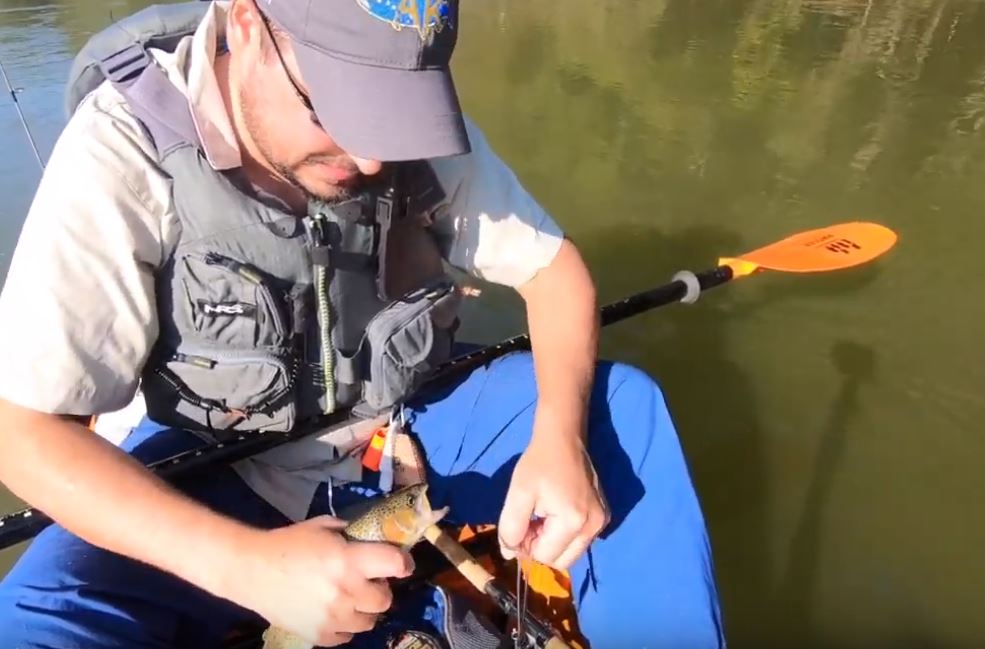
Two Complete Setups: Spin Fishing and Fly Fishing
I get asked about gear constantly. At the river, at club meetings, at the fly shop — people want to know what to buy before they make their first trip down to the tailwater, and they want to know what the experienced hands are actually using rather than what looks good hanging on a peg at the sporting goods store. This article is my honest answer to that question, broken into two complete sections: one for spin fishermen and one for fly fishermen. Both setups are dialed for the specific demands of the Chattahoochee tailwater from Buford Dam south through the Cochran Shoals corridor.
I am not sponsored by any tackle company. The products I recommend here are the ones I personally use, the ones I have seen produce fish over and over in this specific river, and the ones I would buy again if mine disappeared tomorrow. There is no fluff here, no filler recommendations, and nothing I would not stake my own fishing day on.
PART ONE: THE SPIN FISHING TACKLE BOX
The Chattahoochee tailwater is an outstanding spin fishing destination that gets less credit in that department than it deserves, largely because the fly fishing culture on the upper river dominates the conversation. But spin fishing with artificial lures is legal throughout most of the tailwater corridor, extremely effective, and the right approach for a huge percentage of anglers who are not ready to pick up a fly rod. Done right with quality ultralight gear and the correct lures, you will catch trout on the Hooch on a spinning rod as consistently as any method available.
Before I talk about the lures, I need to address the gear that throws them, because gear matters more on this river than most people realize. The tailwater is clear, cold, and pressure-heavy. These fish see a lot of terminal tackle and they are not stupid. You need gear light enough to fish two-to-four-pound fluorocarbon with confidence and accurate enough to place a small spinner into a current seam at thirty feet without overshooting the mark.
THE ROD
My recommendation for the Chattahoochee tailwater is a six-foot to six-and-a-half-foot ultralight or light action spinning rod with a fast or moderate-fast tip. The shorter length gives you better accuracy in the braided river corridor where you are frequently casting parallel to the bank or threading lures between current seams under overhanging vegetation. A rod in this length class also mends light lures far more precisely than a longer rod.
My first choice in this category is the St. Croix Triumph Spinning Rod in the six-foot ultralight configuration. St. Croix builds their Triumph series from SCII graphite with Kigan master-hand guides that handle light line exceptionally well, and the rod has the sensitivity to feel a midge-sized brown trout tick a small spinner in heavy current — a sensation that cheaper rods simply do not transmit. Street price runs around $90 to $110 depending on where you buy it, which puts it in the category of a genuine working tool rather than a collector item. This rod is the one I reach for when I am running small spinners and spoons on the upper tailwater.
If the budget is tighter, the Ugly Stik Elite Spinning Rod in the six-foot ultralight class is a legitimate alternative. Ugly Stik has built their reputation on durability and the Elite series is noticeably improved over the classic GX2 in terms of sensitivity. These rods run around $50 to $60, handle significant abuse, and will catch every trout on this river. I have loaned Ugly Stik rods to first-timers and watched them land brown trout approaching twenty inches. The rod is not the weak link in that equation.
For anglers who want to step up into the $150 to $200 range, the Shimano Sensilite A in the six-foot ultralight is one of the most sensitive blank-through-tip rods in this class. The Sensilite transmits vibration from the lure through the cork grip in a way that genuinely changes how you feel the difference between lure action, bottom contact, and a subtle take. If you plan to fish the tailwater regularly throughout the year and want equipment that rewards skilled presentation, the Sensilite is worth the investment.
THE REEL
The reel on an ultralight trout setup is not an afterthought. You need a smooth drag that can be set light enough to protect two-pound fluorocarbon under the stress of a strong current and still not slip at the start of a fish run. You need a small enough spool profile to cast tiny lures effectively, and you need enough line management quality to avoid the chronic line twist that plagues cheap reels when spinning small inline blades.
My go-to for the Chattahoochee is the Shimano Sedona FI in the 1000 size. The Sedona runs around $50 to $60 and delivers drag performance and smoothness that genuinely competes with reels costing twice as much. The Hagane cold-forged gears that Shimano puts in their mid-range lineup are not marketing language — they actually maintain precise meshing tolerances for years of hard use, and the drag is smooth enough to set at the one-pound range without the jumpiness that kills presentations on light line. The 1000-size spool holds sufficient four-pound monofilament or fluorocarbon for all tailwater applications.
If you want to spend more, the Shimano Vanford FA in the 500 or 1000 size is as good a small spinning reel as exists at any price under $200. The Vanford is genuinely light, smooth, and precise. It is what I use when I am being serious rather than just breaking in a new angler. At roughly $170, it is a reel you will still be fishing twenty years from now if you maintain it.
For the budget-conscious angler, the Pflueger President in the 20 size is one of the most recommended ultralight spinning reels in the industry for legitimate reasons. It runs around $50 to $60 at most retailers, offers ten ball bearings, a carbon drag, and a weight of just over six ounces. I have had Pflueger Presidents in my rod locker for years. They work.
THE LINE
On the Chattahoochee tailwater, line selection is more important than most spin anglers realize. This water is clear, especially in the upper sections below the dam, and the fish in those sections have seen enough monofilament to make them skeptical of bright or heavy line running ahead of a lure.
My first choice is four-pound fluorocarbon as the primary line. Fluorocarbon has lower visibility than monofilament in water, sinks more readily which helps maintain lure depth in current, and has good abrasion resistance against the rocky substrate of the tailwater. Seaguar Invizx in four-pound test is my go-to. It has low memory, excellent knot strength, and a smooth enough surface to cast light lures well from an ultralight spool. For heavier applications targeting larger browns with larger lures, I bump to six-pound Seaguar.
If you prefer monofilament, Berkley Trilene XL in four-pound test in clear or green is a workhorse line that has been producing trout for decades. It is softer and more castable than many cheaper monofilament options and handles the cold water temperatures of the tailwater without the brittleness some lines develop in the forty-degree range.
THE LURES
This is where the conversation gets specific and where I am going to give you exactly what works on this river rather than a generic trout lure list. These are the actual categories and products I carry in my tailwater spin box.
INLINE SPINNERS
The inline spinner is the foundation of tailwater spin fishing and nothing on this river produces more fish per cast, in more conditions, than a well-chosen inline spinner worked at the right speed through productive water.
Panther Martin Classic Spinner. This is the single most important lure in my Chattahoochee spin box and has been for years. The Panther Martin’s distinguishing feature is its body-mounted blade — the blade attaches directly to the shaft through the body rather than spinning on a separate clevis like a Rooster Tail or Mepps. This design means the blade starts spinning the instant the lure begins to move, with essentially no lag at the start of the retrieve or at slow retrieve speeds. In the Chattahoochee’s current-heavy upper tailwater, where you are frequently casting upstream and retrieving just fast enough to maintain blade contact, this matters enormously.
The sizes I carry are the 1/16-ounce (size 1/32 oz body, also labeled as size 1) for clear low-water conditions in the upper tailwater, and the 1/8-ounce for normal to slightly elevated flows. My primary color selection is the gold blade with black body and yellow dots — this is the Chattahoochee’s most consistently productive single spinner combination in my experience, and it will produce fish in water ranging from gin-clear to slightly stained. Secondary choices are the silver blade with yellow body (excellent in bright sun on clear water days), and the gold blade with the original yellow and red spotted body for overcast conditions when you want slightly more flash.
The Panther Martin FishSeeUV series in gold and chartreuse is worth adding if you fish the tailwater in high-pressure or stained water conditions. The UV-reactive coating adds a trigger that standard blade flash does not provide.
Panther Martin spinners are widely available at Bass Pro Shops, Cabela’s, and Academy Sports locations in the Atlanta metro, and range from about $5 to $8 each.
Worden’s Rooster Tail. The Rooster Tail occupies a slightly different niche than the Panther Martin on the Chattahoochee. Its spinning hackle tail design creates a different action profile — slower sink rate, different vibration signature, and a softer overall presentation that sometimes outperforms the Panther in conditions where fish are finicky or where the water is very shallow. I carry Rooster Tails in the 1/16-ounce and 1/8-ounce sizes. Top colors on the Hooch are white with silver blade, black with silver blade, and a rainbow trout pattern. The white Rooster Tail is my go-to on the lower tailwater sections where stocked rainbows have not yet been hammered with typical brown-water lure choices.
One known limitation of the Rooster Tail is blade engagement — the blade can fail to start spinning at very low retrieve speeds, which is less of a problem on the Chattahoochee’s faster upper water but can be an issue in the slower sections south of Morgan Falls. When in doubt on slow water, reach for the Panther Martin.
SMALL SPOONS
The Acme Kastmaster in the 1/8-ounce size is the workhorse spoon for the Chattahoochee tailwater. The Kastmaster’s compact weighted body casts farther per ounce than virtually any other trout lure, sinks quickly to depth in fast water, and produces a tight, fluttering action that triggers both rainbow and brown trout in a wide range of conditions. My primary color choices are chrome (no other color on bright clear-water days), gold (overcast or slightly stained conditions), and the rainbow trout pattern which is essentially a holographic chrome with pink and green flash and is an exceptional Chattahoochee color.
The Kastmaster is particularly effective when the river is running slightly elevated and you need to get a lure to depth fast in the upper tailwater. Cast upstream and across, count down to your target depth, then retrieve just fast enough to maintain that depth. Trout in the upper tailwater will smash a properly worked Kastmaster in the seams behind boulders and in the transition zones at the downstream edges of pools.
The Luhr Jensen Super Duper is the other spoon I always have in my box. The Super Duper is a wider, lighter spoon with a distinct wobbling flutter that is different from the Kastmaster’s tighter action. It works best in slightly slower or shallower water than the Kastmaster handles well, and it is a classic Chattahoochee lure that experienced local anglers have fished on this river for decades. The chrome and red/white combination are my first choices. At around $4 to $6, they are cheap enough to carry a half-dozen without guilt.
CRANKBAITS
The Rapala Countdown Minnow in size CD03 (one and a half inch, 1/16 ounce) is the crankbait I fish when spinner and spoon presentations are not getting follows and I want to change the action profile entirely. The CD03 is a sinking minnow-style crankbait that descends at a counted rate — approximately one foot per second — allowing precise depth control in the pools and runs where large browns hold below midday generation releases. The body action is a tight wobble that mimics injured baitfish in a way that no spinner or spoon replicates.
Top colors for the Chattahoochee are the gold pattern (gold body with black back), silver/black, and the rainbow trout pattern. In late fall and winter when cold-shocked shad and herring are flushed through the turbines, a white Countdown Minnow dead-drifted through the channel edges is one of the most effective big-brown presentations available to a spin angler on this river.
The Rebel Tracdown Ghost Minnow in silver or pearl is a slightly larger option at two inches and also worth carrying in the box. Rebel’s Tracdown series has a similar counting sink rate and produces well in the deeper pool sections below Highway 20 and at Jones Bridge.
MICRO JIGS
The last category in my spin box is micro-jigs, which are essential for the Chattahoochee’s Delayed Harvest section from Sope Creek to US Highway 41 where only single-hook artificial lures are permitted. Micro-jigs — a 1/16-ounce or 1/32-ounce lead or tungsten jighead paired with a small soft-plastic paddle tail or curly tail grub — are the most versatile and effective artificial for slow, methodical presentation in the slower-moving flat water of the lower tailwater and Delayed Harvest section.
The jigheads I use are Owner Ultrahead Round in 1/32-ounce for clear, low-flow conditions and 1/16-ounce for normal flows. Paired with a one-to-one-and-a-half-inch paddle tail grub in smoke, white, chartreuse, or pink, this combination dead-drifts through the current like a nymph and produces fish on days when spinners and spoons get ignored. Berkley Gulp Alive! Minnow in one-inch size is my go-to soft plastic for this application on the tailwater. The material has a subtle scent dispersion that is technically within the artificial-only regulations and the action on even the lightest retrieve is fish-catching.
PART TWO: THE FLY FISHING TACKLE BOX
Fly fishing the Chattahoochee tailwater is one of the great accessible trout fly fishing experiences in the American South. There are world-class guide services operating on this water, a legitimate Trout Unlimited chapter dedicated to its health and restoration, and an angling culture built around it that is deep enough to sustain multiple fly shops within twenty miles of the river. It is also, at times, genuinely technical fishing on pressured water where getting the right fly at the right depth on the right drift matters.
My goal in this section is to give you a complete and honest setup — rod, reel, line, leader, and flies — that will allow you to fish the Chattahoochee tailwater effectively from your first trip forward.
THE ROD
The standard setup for Chattahoochee tailwater fishing is a nine-foot, five-weight fly rod with a medium-fast to fast action. This is the right configuration for the full range of tailwater presentations — indicator nymphing with tandem midge rigs, dry fly fishing in the flat sections during hatch activity, and streamer fishing in the fall and winter. A five-weight has enough backbone to throw weighted nymph rigs with split shot and still deliver a size 22 dry fly without collapsing the presentation.
My first recommendation for anglers in the mid-range budget is the Orvis Clearwater 9-foot 5-weight. The Clearwater has earned its reputation as the best mid-range fly rod in the market through consistent performance and one of the best manufacturer support programs in the industry — Orvis offers a 25-year guarantee on all their rods and has never been difficult about honoring it. The Clearwater’s medium-fast action is forgiving enough for anglers still developing their casting, delivers clean loops at the short to medium distances that dominate tailwater fishing, and handles both delicate midge presentations and weighted indicator rigs without the radical compromise you get from either a very fast or very slow action rod. It retails for around $250 to $280 as a standalone rod, or around $400 to $420 as a combo with a matching reel and line.
The Echo Lift 9-foot 5-weight is an excellent alternative in the $100 to $120 range for anglers who want a credible rod without the Clearwater’s price point. The Echo Lift has surprised a lot of anglers with its performance per dollar. It casts well at short to medium distances, handles indicator rigs without complaint, and is backed by Echo’s lifetime warranty. For a first fly rod on the Chattahoochee, there is nothing wrong with the Lift.
For anglers willing to invest in a rod they will fish for decades, the Sage Foundation 9-foot 5-weight at approximately $450 to $500 is one of the best all-around tailwater rods I have cast. The Foundation’s action is faster than the Clearwater, which rewards the angler who develops their casting over time and wants a tool that keeps improving as their technique does. The Sage name also carries significant credibility at the fly shop counter when you need local advice on conditions, because every guide on this river has fished one.
THE REEL
On the Chattahoochee tailwater, the reel is primarily a line storage device. The fish in this river do not make the kind of extended runs that test drag systems the way saltwater fish or steelhead do. What you need from a fly reel on the Hooch is smooth drag that can protect four- and five-X tippet during a short run from a strong brown, adequate backing capacity to hold your WF5F line plus about a hundred yards of twenty-pound Dacron, and a large arbor design that retrieves slack quickly when a fish runs toward you.
The Orvis Battenkill Disc in the size III (matching a 4-6 weight rod) is my recommendation at the $100 price point. This is a machined aluminum large-arbor reel with a carbon fiber drag stack that is notably smoother than what you get in cast aluminum reels at the same price. It is also tough enough to survive being dropped on river rocks, which will happen.
The Redington Behemoth in the 4/5/6 size is a solid budget alternative at around $60 to $70. It is not the lightest reel available but it has excellent drag for the price and is available at most fly shops and online retailers. For the angler who is just starting out and is uncertain how seriously they will pursue fly fishing, the Behemoth is the right call.
For a step-up reel that will last a serious fly angler a lifetime, the Lamson Liquid in the size 2 (5-weight) at around $130 to $150 is as good a value reel as the market offers. The Liquid uses a sealed conical drag system that is essentially maintenance-free and smoother than anything at twice the price from a decade ago. It is what I would tell a serious angler to buy if they asked me right now.
THE LINE AND LEADER
The correct line for Chattahoochee tailwater fishing is a weight-forward floating line in five-weight, matched to your rod. I fish Rio Gold WF5F as my primary tailwater line. The Rio Gold’s taper profile loads fast-action rods at short distances without requiring the full line length that fast-action rods traditionally need to feel fully loaded, and it presents dry flies and midge emergers with enough delicacy at twenty to thirty feet to fool pressured brown trout. It retails for about $70 to $80.
If the budget is tighter, the Scientific Anglers Frequency Trout WF5F is a legitimate line in the $40 to $50 range that casts well and handles both nymphing and dry fly applications without major compromise.
For indicator nymphing with weighted tandem rigs, some tailwater anglers prefer a longer belly line like the Rio Indicator WF5F, which is purpose-designed for high-stick and indicator presentations and mends better than standard taper lines in weighted nymph applications. At around $80, it is worth carrying as a second spool if you fish indicator rigs exclusively through a season.
Leader setup for the Chattahoochee: for indicator nymphing, I extend a standard nine-foot 3X tapered leader to a total system length of twelve to fourteen feet by adding two feet of 3X fluorocarbon followed by two feet of 4X or 5X fluorocarbon tippet at the terminal end. The total leader-and-tippet length needs to equal roughly one and a half times the depth of water you are fishing to present flies on the bottom. For dry fly fishing with small midge patterns, I use a twelve-foot 5X leader or extend a nine-foot 4X leader with two to three feet of 5X tippet.
My tippet of choice is Seaguar Tatsu fluorocarbon in the 4X and 5X sizes. It is stronger per diameter than most competing fluorocarbon tippet materials, which matters when you are fishing 5X to a large brown trout in current.
THE FLY BOX
The Chattahoochee tailwater fly box is built around midges, with supporting selection for mayfly nymphs, attractor nymphs, dry flies, streamers, and terrestrials. I am going to give you the specific patterns recommended by local guides, the Atlanta Fly Fishing Club, and multiple fly shops that have been operating on this water for decades.
NYMPHS — THE FOUNDATION
Zebra Midge. This is the most important fly in any Chattahoochee tailwater box. Period. The Zebra Midge is a tungsten-beaded midge pupa imitation tied with thread body and wire ribbing — as minimal a construction as a fly gets — and it catches fish on this river in every season, in every section from below the dam south through the Delayed Harvest water. The primary color is black body with silver wire ribbing and a silver tungsten bead. Secondary colors worth carrying are red body with silver bead, olive body with gold bead, and the rootbeer/amber body with a copper bead. Carry them in sizes 18, 20, and 22. The Atlanta Fly Fishing Club specifically identifies the Zebra Midge as the Chattahoochee’s standard, and the pattern has been a primary producer on this water for years. Most fly shops and online retailers carry them in multi-packs.
Copper John. John Barr’s classic attractor nymph is a primary Chattahoochee producer and serves dual function as a heavy point fly in tandem nymph rigs — its copper wire body and slim profile get the rig to depth faster than most other nymphs, and the bead head provides attractant flash. Carry red Copper Johns in sizes 14 and 16 as your default; add the copper/natural version in size 18 for clearer conditions. This fly imitates mayfly nymphs and small stoneflies convincingly enough to produce on natural feeding fish and aggressively enough to trigger reaction strikes from stocked rainbows.
Pheasant Tail Nymph. The bead-head Pheasant Tail in sizes 14 through 18 is one of the most universally productive trout nymphs tied, and on the Chattahoochee it imitates the Baetis (Blue-Winged Olive) nymphs and small stonefly larvae that become more abundant as you move south of Highway 20. Carry the standard bead-head version and the flashback version (with a strip of pearl mylar over the wing case) in sizes 16 and 18. The Pheasant Tail is particularly productive in the mid-tailwater corridor from Highway 20 through Jones Bridge where aquatic insect diversity increases significantly.
Hare’s Ear Nymph. The bead-head Hare’s Ear is perhaps the buggiest-looking nymph in existence — the dubbed hare’s mask body has a spiky, impressionistic quality that suggests a wide range of aquatic insects without precisely imitating any of them. This is a features-not-a-bug situation for the fly fisher. Carry them in sizes 14 and 16. The natural brown/tan color is the primary, with gold bead. The Hare’s Ear is consistently listed by Chattahoochee guides and the Atlanta Fly Fishing Club as a must-have for the tailwater.
Rainbow Warrior. Lance Egan’s Rainbow Warrior is categorized as an attractor nymph, which is a polite way of saying it does not convincingly imitate any single insect but causes trout to strike it anyway. The pearl body, flashy bead, and red thread head are obnoxiously visible in the water and trigger reaction strikes from fish that might ignore a more subtle pattern. The Chattahoochee fly fishing community specifically cites the Rainbow Warrior as one of the river’s top producers, particularly for stocked rainbows that have not yet become selective feeders. Carry in sizes 16 and 18.
San Juan Worm / Ultra Wire Worm. The vermicelli-style red or pink San Juan Worm is one of the most productive flies on the Chattahoochee on any day when the river runs slightly elevated or off-color. Trout, both stocked and wild, eat worms opportunistically and consistently, and a dead-drifted San Juan Worm through a productive seam will often produce fish when nothing else is working. The Atlanta Fly Fishing Club lists the updated UV Worm variant — tied with UV-reactive material and available in pink, chartreuse, and brown — as one of the essential Chattahoochee patterns. Carry in size 14.
Prince Nymph / Formerly Known as Prince. The classic Prince Nymph in sizes 12 and 14 provides a good stonefly imitation for the Chattahoochee’s moderate stonefly population, and the bead-head version works as a point fly in tandem rigs that need more weight and visibility than a Zebra Midge provides at the top of the system. The “Formerly Known as Prince” variant with holographic tinsel wings is a Chattahoochee-specific recommendation from multiple local sources.
DRY FLIES
Griffith’s Gnat. The Griffith’s Gnat in sizes 20 and 22 is the primary adult midge dry fly for the Chattahoochee tailwater. It imitates a cluster of adult midges on the surface, which is the stage at which surface-feeding tailwater trout most commonly take midges when they are rising. Tied with peacock herl body and grizzly hackle palmered over it, the Griffith’s Gnat has enough bulk to be visible at the distances you will be fishing it and enough surface footprint to stay afloat on the gentle surface currents of flat tailwater sections. Carry in black/grizzly in sizes 20 and 22.
Parachute Adams. The Parachute Adams in sizes 16 through 20 is a universally effective dry fly that works on the Chattahoochee during BWO (Blue-Winged Olive) hatches in the mid-tailwater sections, serves as a general mayfly imitation in any hatch, and doubles as a dry indicator when fishing a dry-dropper rig with a small midge pupa dropped below it. The white parachute post is visible enough to track at modest distances even in low light, which is a significant practical advantage.
Elk Hair Caddis. The Elk Hair Caddis in tan (size 16 for spring/summer) and orange (size 14 for fall) is the primary caddis pattern for the Chattahoochee. Caddis hatches on the lower tailwater sections in the afternoons of spring and fall can produce substantial surface feeding from both rainbows and browns, and the Elk Hair Caddis in the right size and color is the correct response. It also serves as an excellent dry indicator in a dry-dropper rig due to its buoyancy and visibility.
Black Ant. A size 16 or 18 black ant is often overlooked in tailwater fly boxes but is highly recommended by multiple sources on the Chattahoochee. Ants fall into the river constantly from the heavily forested corridor, and trout eat them whenever they are available. The terrestrial ant bite on the Hooch runs from late spring through early fall, and a black ant fished near overhanging tree cover on a still surface will occasionally produce fish on days when nothing else is working. Simple foam or dubbed-body black ants are all that is needed.
STREAMERS
White Woolly Bugger. The Woolly Bugger in white, size 6 or 8, is the go-to streamer for the Chattahoochee tailwater during cold snap baitfish die-offs when threadfin shad and blueback herring are flushed through the dam turbines. Dead-drifted on a sink-tip line or twitched through the deep channel edges on a standard floating line with split shot, a white Woolly Bugger is one of the top big-brown presentations available on this river. Carry in white and black, sizes 6 and 8.
Olive/Black Cone-Head Woolly Bugger. For fall and winter streamer fishing on the Chattahoochee, a size 8 or 10 cone-head Woolly Bugger in olive or black is the workhorse. The conehead sinks faster than a standard bead head and gets the fly to depth in the faster runs where browns hold in cold weather. Swing it across and down through tail-outs and let it hang at the end of the swing before retrieving.
White Clouser Minnow. The Clouser Minnow in white and chartreuse/white, sizes 4 and 6, is a baitfish imitation that rides hook-point-up and resists bottom snags effectively while producing a convincing diving action. During winter baitfish kill events, the Clouser Minnow on the Chattahoochee produces large brown trout on a dead-drift through the deep channel sections below the dam and in the deeper runs south of Highway 20.
INDICATOR SYSTEM AND ACCESSORIES
For indicator nymphing on the Chattahoochee, I use an Air-Lock Strike Indicator in the small and medium sizes. The Air-Lock uses a locking screw that allows precise depth adjustment without removing the indicator from the leader, which matters when you are micro-adjusting depth at each new piece of water. In the crystal clear upper tailwater, a yarn indicator or small foam indicator is preferable to the larger slip bobber-style indicators that many anglers use on western tailwaters — the Hooch’s fish are too spooky for oversized terminal presentation.
Split shot: I carry Water Gremlin reusable twist-on split shot in size BB, size AB, and size AAA. The ability to add and remove weight precisely between runs without cutting the leader is essential on a river where you are constantly adjusting presentation depth as water type changes.
Tungsten putty weight as an alternative to split shot is worth mentioning. Loon Outdoors Deep Soft Weight in olive is a moldable tungsten-based putty that threads into the leader without crimping, adjusts without tools, and does not damage fluorocarbon the way improperly applied split shot can. It is my preferred weight for delicate presentations in the flatter sections of the tailwater.
A WORD ON FLY BOXES
Organize your fly box by category, not by the order you bought them. I keep midges in one compartment, attractor nymphs in a second, Pheasant Tails and naturalistic nymphs in a third, and streamers in their own separate streamer box with individual foam slots to protect the hooks. Dry flies in their own compartment, separated from wet flies to keep the CDC and elk hair fibers from getting crushed by wet materials.
The Fishpond Tacky Original Fly Box in the medium size is my current box of choice for nymphs and dries. The sticky silicone surface holds flies securely without damaging hooks, prevents them from rattling loose when the box is dropped, and lets you place and retrieve flies with one hand while managing a rod in the other. These details matter on a moving river where your hands are frequently occupied.
CLOSING NOTE
Whether you are rigging up a spinning rod with a gold Panther Martin and two-pound fluorocarbon or threading a 5X tippet through the eye of a size 20 Zebra Midge at first light, the Chattahoochee tailwater will reward preparation. The fish in this river have been educated by thousands of presentations and they will ignore sloppy technique and incorrect gear choices. Get the setup right, learn the water, check that dam release schedule before every trip, and this river will deliver some of the most consistently rewarding trout fishing available anywhere within driving distance of a major American city.
The local fly shops — Alpharetta Outfitters, The Fish Hawk in Buckhead, and the Orvis locations in the metro area — all carry most of what I have described here and have staff who fish this river personally and can steer you toward current conditions and what is producing. If you are getting started on the Hooch, walk into one of those shops before your first trip. They will not steer you wrong.
Leave a Reply